The Pass: How Great Kitchens Communicate Under Pressure
Kitchens say 'heard' and think the loop is closed. It is only half closed. Here is how the pass works, and what to borrow from hospitals to fix it.
On this page
Kitchen communication under pressure works when three things are true: calls are short and standard, every call gets a response, and one person owns the flow of tickets at the pass. Everything else, the volume, the swearing, the theatre, is optional and mostly unhelpful.
Kitchens usually get the first two roughly right. The weak point is what the response actually proves.
What is the pass, and who runs it?
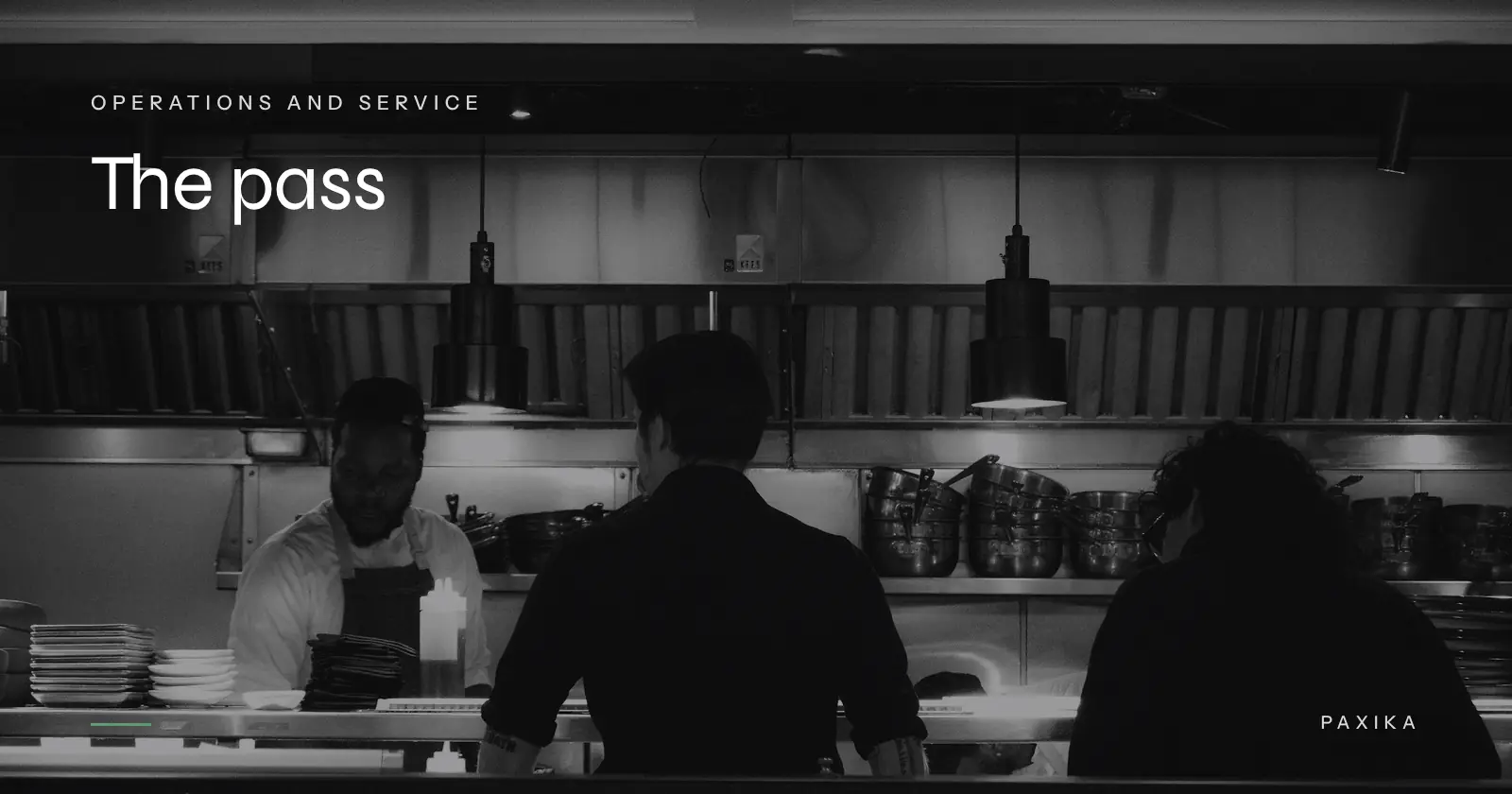
The pass is the counter where finished plates wait for servers or runners, and it is the kitchen's last checkpoint. Before a plate leaves, someone checks that it has the right components, looks presentable and matches special requests or allergy notes, as Food Republic's explainer on the expo role describes it.
That person, the expeditor or expo, is often the head chef, chef de cuisine or sous chef. They read tickets, relay them to stations so cooks can stay on their own work, and time dishes so that parts from different stations finish together.
The design choice behind this is simple. Information enters the kitchen at one point and leaves at one point. The pass is both.
What do the standard calls actually do?
Standard calls remove interpretation. "Order in" says a ticket has arrived. "Fire" says start now. "Order up" tells the floor a dish is ready. In the example Food Republic gives, "order fire, arugula salad" starts the first course, while a later pork chop is only announced as coming, then fired when the table is ready for it.
Words differ between kitchens and countries. What matters is that a new cook can learn the set in a week, and that nobody invents their own on a Saturday night.
Movement calls matter too. Escoffier's guide to kitchen communication lists "behind", "corner" and "hot pan", plus knocking twice before opening a walk-in door. These are small, and they prevent injuries.
Why is "heard" only half a loop?
"Heard" confirms receipt, not understanding. A cook who says "heard" after "table twelve, one fish, no butter, allergy" has told you the sound arrived. You do not know which part they kept.
Healthcare teams have a name for the full version. The US Agency for Healthcare Research and Quality describes a check-back as a closed-loop strategy in three steps: the sender calls out the information, the receiver repeats it back, and the sender confirms the repeat was accurate. The agency says check-backs help reduce misunderstandings, which can lead to serious errors in clinical settings.
A kitchen is not a ward, and most tickets do not need this. But a few do.
"Heard" tells you the message arrived. A repeat-back tells you what arrived.
When should a kitchen use a repeat-back?
Use a repeat-back whenever a mistake would be expensive, unsafe or hard to undo. A simple rule of thumb: if you would be unhappy to learn the call was misheard after the plate left, close the loop.
In practice that means:
- Allergies and dietary needs. The expo calls it, the cook repeats the allergen and the dish.
- Modifications to a fired dish. "Table nine, hold the lamb two minutes" gets "Table nine, lamb, two minutes."
- Changes to stock. An item going off the menu is repeated by every station that uses it.
- Handoffs between shifts. The outgoing lead names what is prepped and what is short, and the incoming lead says it back.
Routine fire calls can stay on "heard". Not everything is a safety matter, and a line that repeats every word slows itself down.
How do you keep it calm when the board is full?
Calm comes from fewer voices, not quieter ones. Escoffier's guide points to the brigade system's chain of command: during service the lead directs the line, which cuts confusion and extra chatter. Cooks still need an upward route, such as telling the lead at once when a station is falling behind, so the team can adjust together.
Some practical rules:
- One caller per ticket. If two people are issuing instructions to the same station, someone is wrong.
- Say the problem early. "Behind on table six" at minute two is useful. At minute ten it is an incident.
- Pair voice with paper. The Escoffier guide recommends combining spoken calls with printed tickets or screens, which catches missed messages and helps staff with hearing or language barriers.
- Correct the system, not the person. Tone matters: firm and clear, never an accusation across the line.
A common mistake and its fix
The usual mistake is treating communication as personality. "She is loud, so she runs a good pass." A good expo is consistent, not loud.
The fix is to write the calls down. A one-page list of calls, the response expected, and the short list of things that always get a repeat-back is enough. Put it in your operations manual, teach it in the first shift, and spot-check it in service. If the layout forces cooks to shout across a room, the problem may be the floor plan, so look at kitchen layout as well.
Key takeaways
- The pass is the single point where information enters and plates leave. Give it one owner.
- Keep calls short and standard, and write the list down so new cooks learn it in days.
- "Heard" confirms receipt, not understanding.
- Use a three-step repeat-back for allergies, modifications, stock changes and shift handoffs.
- Raise problems early and pair spoken calls with a ticket or screen.
- Judge an expo on consistency, not volume.
Questions people ask
What is the pass in a restaurant kitchen?
The pass is the counter where finished plates are set for servers or runners to collect. It is also the last checkpoint: someone, usually the expeditor or head chef, checks that each plate has the right components, looks right and matches any special requests or allergy needs before it leaves the kitchen.
What does an expeditor do?
An expeditor, or expo, sits between the kitchen and the dining room. They read the tickets, call orders to each station, time dishes so the parts of a table's order finish together, check plates at the pass and tell the floor when food is ready. In many kitchens a chef takes this role.
What does 'heard' mean in a kitchen?
'Heard' is the acknowledgement a cook gives when a call has been received. It tells the caller the message landed, so they do not have to repeat it. It does not prove the cook understood the detail, which is why critical information deserves a short repeat-back as well.
What is closed-loop communication?
Closed-loop communication has three steps: the sender gives the information, the receiver repeats it back, and the sender confirms the repeat is correct. Healthcare teams use it to reduce misunderstandings. The same pattern suits kitchens, especially for allergies, modifications and changes to timing.
Sources
Read next
Operations & service
Commercial Kitchen Layout: Principles for Flow, Safety and Speed
A kitchen plan works best as a map of paths rather than a drawing of equipment. Trace four of them, count where they cross, and find your layout problems before you build.
Operations & service
Table Turn Time: Seat More Guests Without Rushing Anyone
Faster tables do not need faster guests. Split every visit into guest time and house time, then shorten only the house time: the waits for menus, food, the bill and the reset.
People & careers
Restaurant Staff Retention: What Actually Keeps People
People rarely leave a restaurant for one reason. An essay on the three things that tend to keep them, a rota people can plan a life around, a visible next step, and being known.