Social Media for Restaurants Without a Marketing Team
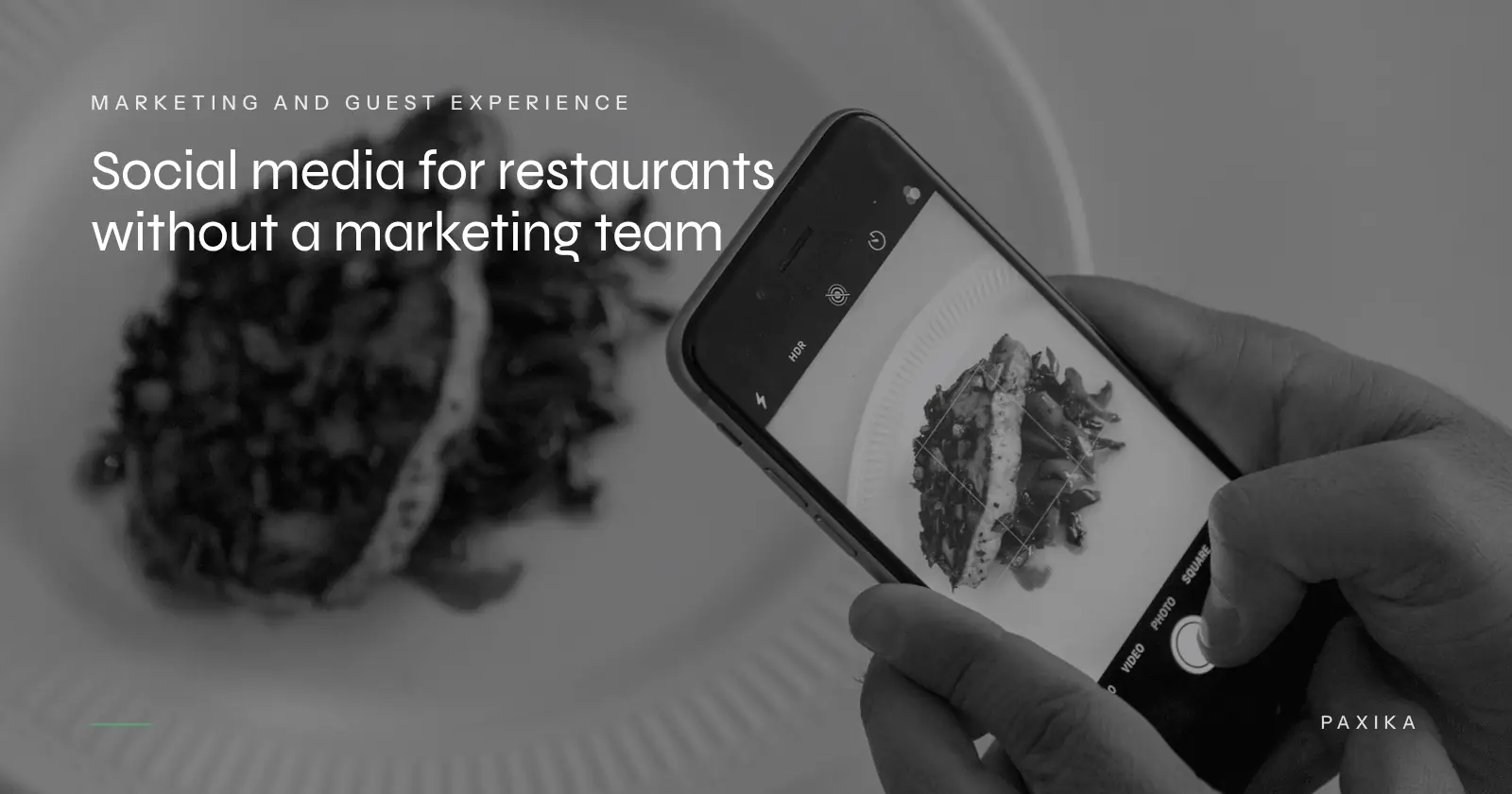
You do not need a marketing team to run restaurant social media. You need a short weekly routine and a bank of content that comes straight from service.
On this page
- What is social media actually for in a restaurant?
- How much time does it really take?
- What should a restaurant post?
- Which platform should you choose?
- How do you handle comments, messages and criticism?
- What does a working week look like?
- How do you know it is working?
- What quietly breaks a social media routine?
- Key takeaways
Restaurant social media does not need a marketing team. It needs one person, one weekly session and content that comes from service rather than from a shoot. The mistake most small venues make is treating it as a second job on top of running the room. Treat it as a record of the first job instead.
Before you plan anything, look at how guests actually find new places. A Toast survey of about 1,450 US adults fielded in October 2025 put word of mouth first at 38%, walking or driving past at 30%, Facebook at 27%, Instagram at 15% and TikTok at 14%. Among Gen Z, TikTok came first at 38%. These are US figures, so check them against your own guests, but the shape is useful: the two biggest routes, word of mouth and passing the door, both happen offline.
What is social media actually for in a restaurant?
Its main job is to give people something to pass on. If word of mouth is still the top way a restaurant gets found, then a post is a prop for that conversation and cannot replace it. Often it is the second look: a friend names you, and the guest checks your profile before booking. That second look needs to match what the friend said.
That changes what you make. A guest who tells a friend about you needs a name, a dish and a reason. Your posts should hand them all three: the dish by name, the room as it looks on a Tuesday, the person who made it.
It also changes what you measure. A post that three guests send to their group chat is worth more than one that collects a few hundred passing likes.
How much time does it really take?
Plan for about three hours a week, in one fixed slot, with one person responsible. That is a decision rule, not a statistic: if you cannot protect three hours, cut the number of platforms rather than the quality.
A routine that holds up in a busy venue:
- Thirty minutes of filming during prep or service. Capture raw clips, not finished posts.
- Forty-five minutes of editing and captions, done in one sitting so you stay in the same voice.
- Fifteen minutes to schedule the week's posts using the platform's free scheduler.
- Thirty minutes on replies and messages across the week, in small slices.
- Thirty minutes of looking at what happened: saves, shares, enquiries.
- Thirty minutes to plan next week from the bank below.
Name a backup. When the person is on holiday, the plan is a pre-scheduled week, not silence.
What should a restaurant post?
Post what is already happening, and repeat the formats that work. A small content bank is easier to keep than a calendar of ideas.
- The dish. One plate, one angle, natural light, the name and a single line on why it exists.
- The process. Hands, heat, a station being set. Short and without voiceover.
- The room. Before service, when the light is good and the tables are laid.
- The people. Who is on tonight, what they would order, how long they have been here.
- The supplier. A delivery arriving, a crate opened, a name credited.
- The change. A new dish, a dropped dish, a seasonal swap. It gives regulars a reason to return.
A good post is a menu item for people who are not here yet.
Film once and cut many times. Twenty minutes at the pass on a busy evening can yield a month of clips if you keep the raw footage in one folder named by date.
Which platform should you choose?
Choose the platform your own guests use, not the one a consultant is excited about. Ask ten regulars where they look for restaurants and take the answer seriously.
Some reference points. In the Toast survey above, Instagram and TikTok sat at similar levels overall (15% and 14%), while TikTok led strongly with Gen Z. An MGH survey of 1,142 US TikTok users found 58% had visited a restaurant after seeing it on the app. That sample was people already watching TikTok and the agency has an interest in the result, so read it as a sign of potential, not as the average diner.
A simple split for a small team:
| Channel | Best used for | Effort |
|---|---|---|
| Dishes, room, regulars; the default for most venues | Medium | |
| TikTok | Process clips and personality, if your guests are young | Medium to high |
| Events, older local audiences, community groups | Low | |
| Google profile | Hours, menu, photos, replies; where booking decisions are made | Low but vital |
Pick one main channel, keep the others accurate rather than active, and revisit the choice after three months. Your local search presence usually does more for walk-in and booking decisions than any single post.
How do you handle comments, messages and criticism?
Reply to everything, quickly and in a human voice. A reply is the cheapest hospitality you will give all week, and it is public.
Three habits help:
- Answer booking questions with a link or a direct next step, not a "DM us".
- Thank people by name and mention the dish they enjoyed.
- Treat a complaint as service recovery. Acknowledge, fix, and move to a private channel. Our guide to responding to negative reviews covers the wording.
What does a working week look like?
Picture a hypothetical 40-seat bistro with a four-person kitchen and one floor manager who likes taking photos.
On Tuesday, before service, the manager films the room for ten seconds and the pastry station for thirty. On Thursday she records the chef plating the evening's special and asks a regular if she can tag her. On Sunday she spends an hour cutting the clips, writing captions that name each dish, and scheduling four posts and a handful of stories for the week ahead.
Nothing in that week needed a script, a hired shoot or a new idea. It needed a phone, a habit and a rule that every post names a dish, a person or a change.
How do you know it is working?
Count what leads to covers. Likes are a mood; bookings are a result.
Keep a simple weekly tally in a notebook or spreadsheet:
- New guests who say how they heard of you (ask at the door or add a field to your booking form).
- Saves and shares on your top three posts.
- Booking enquiries that arrive by message.
- Profile visits compared with reservations in the same week.
After eight weeks, look for patterns. If process clips travel and room shots do not, make more of the first. Write down the quiet weeks too: a week with no signal is information, not failure.
What quietly breaks a social media routine?
A handful of habits account for most of the silence and the wasted effort.
- Posting in bursts, then vanishing. Schedule a week at a time and shrink the plan until you can keep it.
- Stock-looking food shots. Shoot in the dining room in daylight, plated as served.
- Everything is an offer. Aim for roughly one promotional post in four and let the rest show the place.
- Nobody owns it. One named person and one backup solve this.
- No link to bookings. Keep the booking link and opening hours current in your bio and on your Google profile.
- No follow-up. Capture emails and phone numbers at the table so you are not renting your audience. See loyalty and email.
Key takeaways
- Word of mouth is still the top discovery route, so make posts easy to pass on.
- Protect about three hours a week with one named person and a backup.
- Build a content bank from service: dish, process, room, people, supplier, change.
- Choose one main platform based on where your own guests look.
- Reply to every comment and message; it is hospitality, in public.
- Judge results by enquiries, saves and new guests who mention a post, not by likes.
Questions people ask
How often should a restaurant post on social media?
Consistency matters more than volume. For a small team, three to four posts a week plus daily stories is a sensible ceiling, and fewer is fine if you can keep it up. A restaurant that posts twice a week for a year beats one that posts daily for a month and then goes silent.
Which platform should a small restaurant start with?
Start with the one your own guests already use, and check where that is. Ask ten regulars. Most restaurants do well to pick one main platform, usually Instagram or TikTok, and keep Facebook and a Google profile accurate, rather than spreading effort across five networks.
Who should run a restaurant's social media?
One named person, with a backup. It can be a floor manager, a sous chef or a front-of-house lead who enjoys it. Give them a fixed weekly slot and clear boundaries on what can be posted. Shared passwords and shared responsibility usually mean nothing gets posted.
Do I need to pay for a photographer or influencers?
Not to begin with. A recent phone, natural light and thirty minutes at the pass cover most needs. Pay for photography once a year if you want clean images for your website and press. Treat influencers as an experiment with a small budget and a clear way to measure visits.
How do I know if social media is working?
Look for signals that connect to covers, not only likes. Ask new guests how they heard of you, track saves and shares, count direct messages about bookings, and watch profile visits against reservations in the same week. A small, regular tally beats a dashboard you never open.
Sources
Read next
Marketing & guest experience
Restaurant Marketing Plan: A Calm 12-Month Framework
A restaurant marketing plan that fits on one page: one job per quarter, built around empty seats and the second visit rather than a calendar of posts.
Marketing & guest experience
Local SEO for Restaurants and Hotels: Rank on Maps and in AI Answers
Google ranks local results on relevance, distance and prominence, and AI answers draw on the same few sources. The practical job is one accurate fact sheet, repeated everywhere, then tested.
Marketing & guest experience
Email and Loyalty Programs for Independent Venues
For an independent venue, a restaurant loyalty program starts with an email list and a habit of recognising guests. This guide covers capture, reward choice, a simple cadence and the numbers to watch.