Nordic Hospitality: Lessons in Simplicity from Copenhagen to Reykjavik
Nordic hospitality is usually sold as minimalism and candles. The more useful lesson is quieter: simplicity works when a shared set of rules and a lot of trust sit underneath it.
On this page
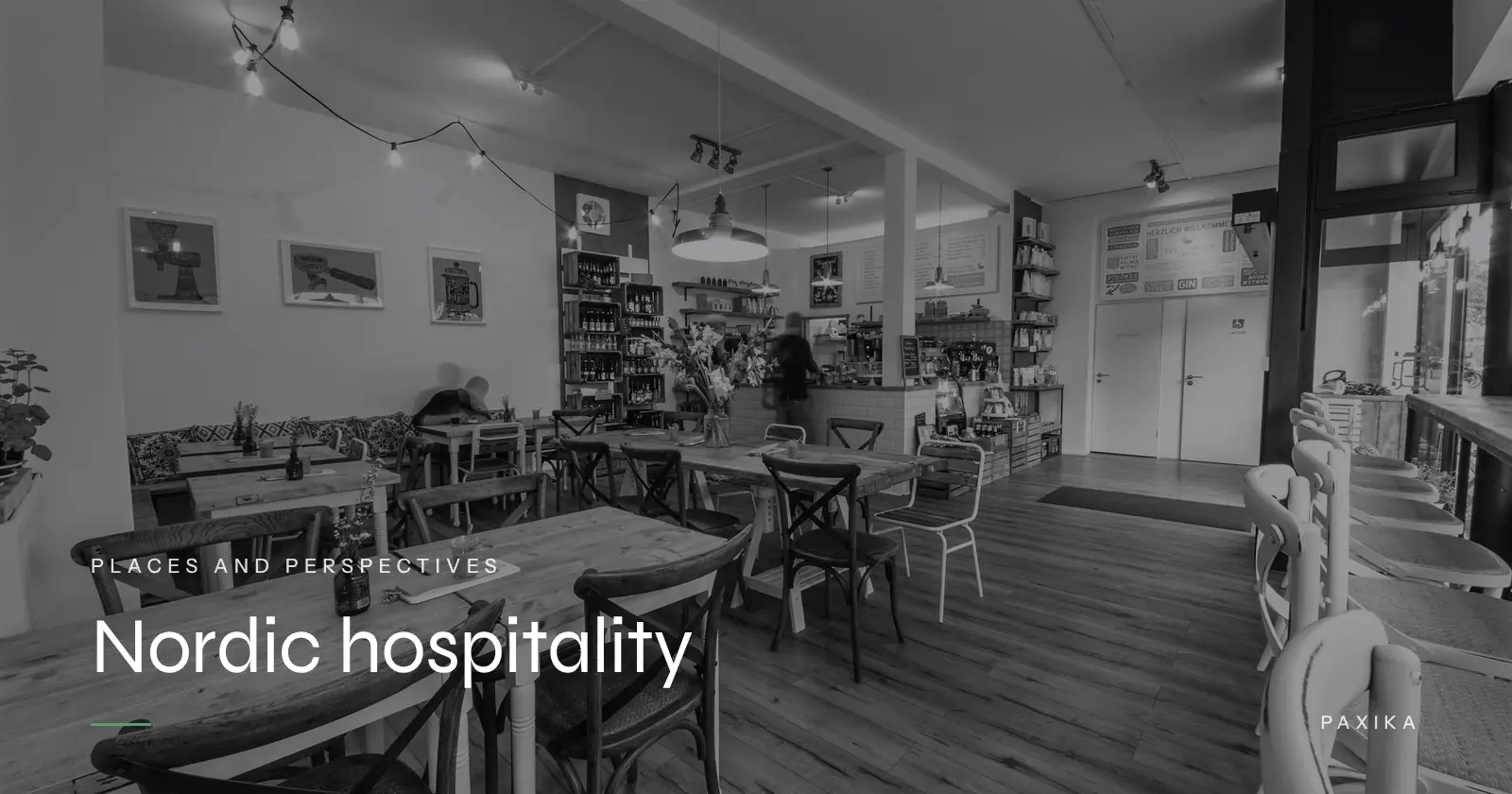
Nordic hospitality is usually described as minimalism: pale wood, wool throws, candles. The more useful lesson is quieter. Simplicity works in the Nordic countries because a shared set of rules and a good deal of trust sit underneath it. Take away the trust and the candles are just decoration.
This essay looks at four ideas that travel, using official and published sources, and tries to avoid treating five different countries as one.
Is there one thing called Nordic hospitality?
No. Denmark, Finland, Iceland, Norway and Sweden have different languages, histories and habits, and what follows is a set of patterns, not a national character.
Hygge shows the problem. Wikipedia's summary of the research describes it as a word in Danish and Norwegian for a cosy, contented mood. It also reports that hygge's status as a core cultural identity is mostly Danish, and that in Norway it is just a word, similar in status to "cosy". The same page notes scholars who see Danish organisations using hygge as a soft power tool, and one source calling its translation into English highly problematic.
So when a restaurant in another country calls itself hygge, it is borrowing a branded idea. That is fine. It is just not the whole story.
What did the Nordic kitchen actually promise?
It promised simplicity joined to ethics, in writing. The New Nordic Food manifesto was formulated in November 2004 at the Nordic Kitchen Symposium in Copenhagen, organised with the Nordic Council of Ministers, and signed by twelve chefs from across the region, including René Redzepi and Mathias Dahlgren.
Its first aim is "to express the purity, freshness, simplicity and ethics we wish to associate to our region." Others ask for meals that reflect the seasons, ingredients suited to local climates and waters, animal welfare, and cooperation with producers, researchers and authorities.
Notice the pairing: simplicity sits in the same sentence as ethics, so it reads as a discipline more than a look. A simple plate is simple because the decisions behind it were hard: what to buy, from whom, and when.
Wikipedia's account adds that Nordic ministers backed the effort in 2005 and that EUR 3 million in funding followed in 2006. A cooking movement became a regional programme. That is a lesson in itself, and a reason the idea spread. The same page names Copenhagen's Noma and Geranium, Oslo's Maaemo and Sweden's Fäviken, which closed in 2019, among the restaurants that took up the approach. Different kitchens, one shared vocabulary.
If you want the practical version, our guides to seasonal menu planning and buying direct from producers show how to start.
Can shared rules replace policing?
Sometimes they can, when the rules are simple and widely understood. The clearest example is not a restaurant at all, but the right of public access.
Sweden's environmental agency says the right, allemansrätten, is built on shared responsibility and asks everyone to respect wildlife, nature, landowners and fellow outdoor enthusiasts. Summaries of Nordic access rights describe the principle in four words: do not disturb, do not destroy. The same summary notes that Norway's right is codified, with specifics such as camping at least 150 metres from inhabited buildings, while Finland's is not codified in a single law.
The boundaries are concrete. The same summary lists, for Norway, no open fires in forest areas from mid-April to mid-September unless a fire is clearly unlikely, and a two-day limit on staying in one spot without the landowner's permission. They are few, specific and easy to explain, which is why they are easy to follow. Each one also carries a reason a person can say aloud (fire risk, the landowner's privacy), and a rule with a stated reason needs less policing.
Three countries, three legal forms, one shape: a short principle, a few boundaries, and trust that most people will behave.
A short principle that guests understand beats a long rule that staff have to enforce.
Try this on your own house rules. Take the list taped behind the bar or printed at the bottom of the booking page, and see whether it can be reduced to one sentence of principle plus two or three real limits. For example: "Be kind to the neighbours" and "last orders at eleven".
This will not work everywhere. The access rights rest on decades of shared habit, and a new business has not earned that yet. Start with your regulars and widen it.
What does a sauna teach a restaurateur?
It teaches that a place can be warm, open to all, and nearly rule-free in tone. UNESCO's entry on sauna culture in Finland, inscribed in 2020, says it is an integral part of the lives of the majority of the Finnish population, with 3.3 million saunas for 5.5 million inhabitants, and describes the element as readily accessible to all.
Two details are useful. The entry says sauna traditions are commonly passed down in families, with universities and sauna clubs helping to share knowledge. And it says public saunas in cities nearly disappeared after the 1950s, before new ones were built through private initiatives.
For hospitality, the second detail matters. A public warmth that went missing came back because small businesses chose to rebuild it. That is a quiet case for what the third place economy tries to describe: somewhere that is neither home nor work, and costs little to enter.
Iceland has its own version. Visit Reykjavik describes 18 geothermal swimming pools in the city and presents them as a way to follow in the footsteps of locals.
What is simplicity, then, in practice?
It is the removal of friction your guest would not have chosen, not the removal of everything. The pattern across these examples is consistent:
- A principle first. One sentence that explains why, before the list of rules.
- The season sets the menu. The change is a reason to return, not a limitation.
- Something open to everyone. A bench, a bar seat, a free tap, a room for the neighbourhood.
- Producers named. Trust is easier when people can see where things come from.
- Warmth that is built, not bought. Light, heat and texture matter more than brand.
Copying the look while skipping the reasoning produces a bare room with expensive chairs, which is only empty. Write down what you are choosing not to do, and why, then check that every object in the room agrees. A subtraction test helps: name the guest need each item serves, and remove what serves none.
A fair caution too: simple does not mean cheap. Simplicity of idea and the price to the guest are separate questions, and a restaurant can be plain about one while charging a lot for the other. Decide which one you are promising.
A test you can run this week
Pick one corner of your business and ask whether a stranger would feel welcome there without buying anything. Then ask whether a new team member could explain, in one sentence, why it is that way. If either answer is no, the simplicity is cosmetic. If both are yes, you have something worth protecting when growth tempts you to add more.
Key takeaways
- Nordic hospitality is a set of patterns across five countries, not one culture. Hygge is mainly a Danish idea.
- The 2004 New Nordic Food manifesto joins simplicity to ethics, seasons and local producers.
- Short shared principles can replace long rules where there is trust. Build that trust with your regulars first.
- Public warmth, such as the Finnish sauna, can disappear and be rebuilt by small businesses.
- Borrow principles, not props. Write down what you choose not to do, and why.
Questions people ask
What defines Nordic hospitality?
There is no single definition, because Denmark, Finland, Iceland, Norway and Sweden differ. Common threads in the sources include simplicity tied to ethics, cooking that follows the seasons and the region, and widely shared public goods such as access to nature and saunas. Treat hygge as mainly a Danish idea rather than a pan-Nordic one.
What is the New Nordic Food manifesto?
It is a ten-point statement formulated in November 2004 at the Nordic Kitchen Symposium in Copenhagen, signed by twelve chefs from across the Nordic region. It asks cooking to express purity, freshness, simplicity and ethics, to reflect the seasons, and to promote local products, producers and animal welfare, according to the Nordic Council of Ministers.
Is hygge the same across Scandinavia?
No. Wikipedia's summary of the research describes hygge as a Danish and Norwegian word for a cosy, contented mood, but says its status as a core cultural identity is mostly Danish, while in Norway it is just a word similar in status to cosy. It also notes critics who see hygge used as a soft power tool.
What can a restaurant outside the Nordics borrow from this?
Borrow the principles. Write a short set of house principles in place of a long list of rules, tie the menu to what is in season nearby, and make one part of your space welcome to everyone, not only paying guests. These ideas cost little and do not depend on pale wood or a particular style of decor.
Are Nordic hospitality models easy to copy elsewhere?
Only in part. Practices such as the right of public access rest on shared trust and law built over a long time, and they are not just a design choice. Where that trust is lower, rules may need to be more explicit. Test one principle at a time, and watch how your guests actually behave.
Sources
Read next
Places & perspectives
Omotenashi: What the World Can Learn from Japanese Hospitality
Omotenashi is often described as a mood. The research suggests it is closer to a system: training, shared feedback, and respect for the guest's choice. Here is what travels.
Places & perspectives
Top 10 Cities for Hospitality Entrepreneurs in 2026
Ten cities from five regions, judged on demand, ease of setup, cost of space and labour, food culture and the professionals you can hire. An editorial ranking, with a caveat for each.
New formats
Slow Hospitality: The Case for Fewer Covers and Deeper Experiences
Slow hospitality runs on a different sum: more value from each seat-hour, less strain on the team, and time that guests feel they have paid for.